
Precision Intelligence · Idea Validation
Validate your startup idea on commercial viability.
Precision Intelligence·12 deliverables
- Commercial Verdict
- Performance Scores
- Market Viability
- Execution Reality
- Strategic Takeaway
- Revenue Estimates
- SWOT Analysis
- Ideal Customer Profile
- Unit Economics
- Willingness to Pay
- Prioritised Insights
- Engineer Strategy
The job
Founders ship ideas based on enthusiasm and abandon them based on doubt — never on evidence.
The Idea Score gives you a defensible signal: not whether you like the idea, but whether the commercial math, the wedge, and the distribution actually support it. Idea validation that survives contact with your own scepticism.
The real report
A validated idea, up close.
The actual Precision Intelligence report — performance scores, strategic takeaway, revenue estimates, SWOT, the ideal customer profile, and the strategic insights. Open it and scroll the whole thing.
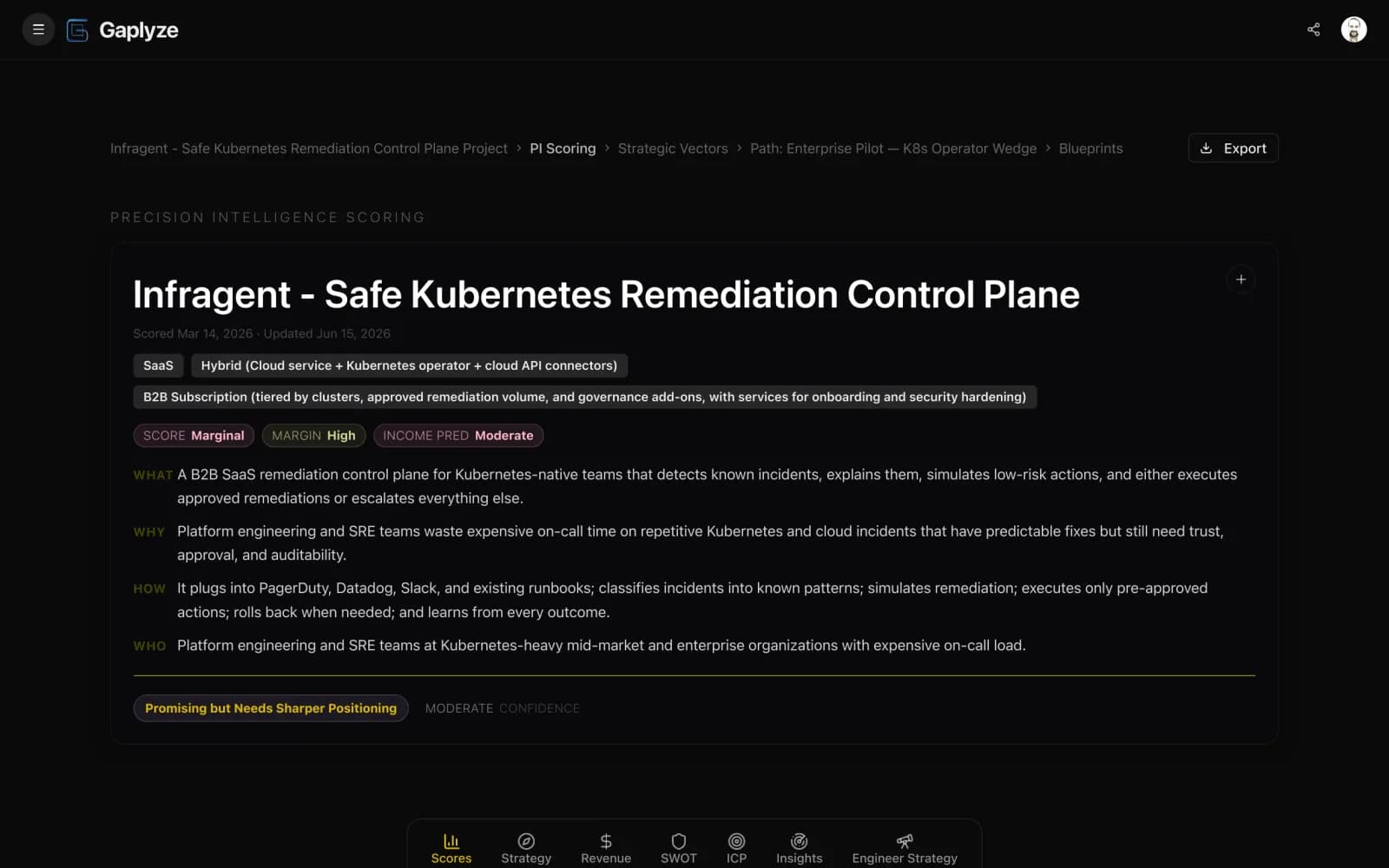
Inside the Precision Intelligence report
The verdict is the entry point. The breakdown is the product.
Idea Score is a structured commercial-viability lens — performance scores, a strategic takeaway, revenue estimates, SWOT, an ideal customer profile, and prioritised insights, each one auditable.
Demand signal
Does a real customer feel the problem with enough urgency to switch their workflow? Demand surfaces signal quality, recency, and whether the pattern compounds or decays.
Wedge architecture
What is the sharpest single thing your product does that the incumbent does not? Wedge clarity separates ventures that scale on conviction from ventures that scale on capital.
Distribution posture
Are there channels you can ride with the resources you actually have? Distribution weighs paid economics, organic readiness, and the founding team's own channel muscles.
Unit-economics shape
Does the math work at sub-scale and at scale? Economics surfaces gross-margin posture, CAC ceilings, payback period, and the contribution-margin shape you'd defend at Series A.
Defensibility
What stops a faster competitor from copying the wedge in a quarter? Defensibility looks for compounding moats — network effects, data loops, switching costs — over surface advantages.
Founder fit
Are you the operator who should be building this venture? Founder-fit reads your distribution channels, your domain credibility, your customer relationships, and your sustainable energy.
Strategic takeaway + insights
Every score resolves into a Must-Do / Must-Not-Do takeaway and prioritised insights — so the number turns into the next concrete action, not a verdict you stare at.
Downstream inheritance
The score isn't a terminal artifact. Strategic Vectors reads the breakdown and engineers strategic paths that LIFT the weak dimensions — turning diagnosis into options.
Every dimension auditable. Every verdict defensible. Every insight actionable.
Decision unlocked
Idea validation that turns enthusiasm into a verdict you can defend.
Know whether the idea passes a basic viability bar before you commit a year
See which dimension to invest in next — refinement, distribution, or proof
Carry a defensible verdict into investor and co-founder conversations
Where it fits
The pivot of the Gaplyze chain.
Idea Generator
Refinement
Idea Score
Strategy Map
Blueprints
Idea Generator
Refinement
Idea Score
You are hereStrategy Map
Blueprints
Scoring is where ideas become bets. Clear the bar and the Strategy Map, Market Intelligence, Blueprints, and investor-ready exports unlock automatically.
Start free
Validate your first idea — on the house.
No credit card. Get the commercial verdict and the full breakdown for free. Upgrade only when you want deeper opportunity quantification, market intelligence, or investor-ready exports.
FAQ
Scoring questions answered.
How is the Idea Score computed?
Each scored idea is evaluated across the commercial-viability dimensions that matter — Demand, Wedge, Distribution, Economics, Defensibility, and Founder Fit. The overall score weights and aggregates the per-dimension signals into a single result you can compare across candidates.
What do the scoring dimensions actually mean?
Demand asks whether the customer feels the problem now. Wedge asks whether the entry angle is sharp. Distribution asks whether you can reach the customer. Economics asks whether the unit math works. Defensibility asks what stops a fast follower. Founder Fit asks whether you're the right operator to ship it.
Is this Idea Validation or Opportunity Quantification — what's the difference?
Both. Idea Validation is the qualitative judgement: is this idea worth building? Opportunity Quantification is the quantitative breakdown: how big is the bet, on which dimensions, with how much confidence? Gaplyze gives you both in the same score — the rank tells you yes/no, the dimensions tell you why.
How often should I re-score an idea?
Re-score whenever something material changes: a refinement, a new customer signal, a competitor move, or a wedge pivot. The score is a snapshot of conviction — when the inputs change, refresh the snapshot.
What does a low score mean — should I abandon the idea?
Not necessarily. A low score points to the dimension that's holding the idea back — often it's distribution or wedge, not the idea itself. Refine that dimension and re-score; the gap usually closes.
Can I use the score in investor conversations?
Yes — that's exactly what Opportunity Quantification is designed for. The score and its dimension breakdown become the spine of an investor-ready memo: defensible reasoning, auditable evidence, and a clear bet you're asking the investor to back.
Stop guessing. Validate it.
Get the commercial verdict, the dimension breakdown, and the opportunity-quantification signal — in one scoring pass.