
Regulatory and Trust Blueprint · Compliance Posture
The regulatory posture every enterprise asks about.
Regulatory + Trust Blueprint·12 deliverables
- Obligations Register
- Controls Matrix
- Trust Center
- Positioning Frame
- Data Residency
- Encryption
- Access Controls
- Audit Log
- Vendor DPAs
- Incident Runbook
- Evidence Register
- Downstream Feed
When it triggers
Regulatory posture only scopes once the data and buyer are locked.
The Regulatory and Trust Blueprint unlocks after you've scored the idea and picked a strategic path — so obligations, controls, and trust signals all map to a known buyer and a known data regime.
Step 1
Score the idea
Idea Score sets the commercial premise
Step 2
Pick a strategic path
Strategy Map locks the buyer + data regime
Step 3
Generate Regulatory and Trust Blueprint
This page
Strategic input
The blueprint inherits the work you've already done.
Obligations, controls, and trust-center entries are framed by the same buyer and data regime that drove your scored idea.
From Strategy Map
- Selected path: which buyer the trust posture has to satisfy
- Data regime: which data the product touches (PII / PHI / financial / model inputs)
- Kill criteria: signals the regulatory posture is unachievable in this market
From Market Intelligence
- Competitor compliance posture — the baseline buyers already expect
- Region-specific obligations relevant to your audience
- Vendor-risk benchmarks in your space
The real surface
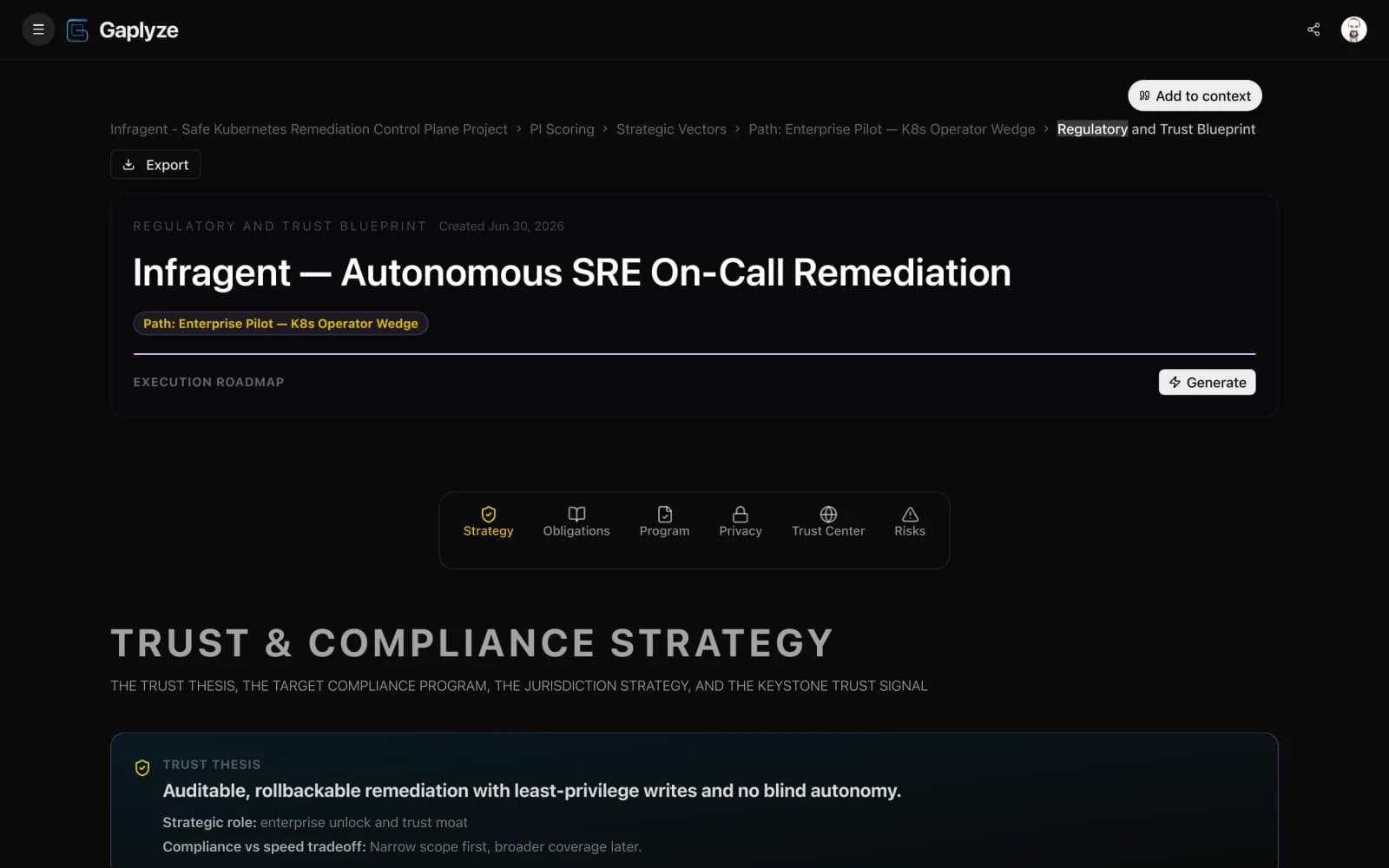
A positioning frame, an obligations matrix, and a trust center.
The actual Regulatory and Trust Blueprint — the compliance positioning frame, the obligations control matrix, and the trust-center register your team can publish and an auditor can verify. Open it and scroll the whole thing.
Roadmap outputs
From blueprint to delivery plan.
The execution roadmap sequences hygiene, evidence, and audit work into phases — so the audit window opens with controls already proven.
Phase 1
Baseline hygiene
Encryption + IAM + audit logging in place
Phase 2
Audit-ready evidence
Standing evidence per control + vendor DPAs
Phase 3
Trust center + audit
Public trust page + SOC2 audit window
Prompt-pack outputs
Briefs your AI coding agent can ship.
Every control and trust artifact becomes a context-rich brief — scope, owner, evidence shape — so your AI coding agent ships consistent implementations across the program.
Control implementation brief — encryption / IAM / audit logging shape
Evidence-collection brief — owner / cadence / artifact per control
Trust center page brief — the public-facing posture write-up
Vendor review brief — DPA template + sub-processor registry shape
Sibling blueprints
Pairs cleanly with — and stays distinct from — these.
Technical Blueprint
Implementation of the controls
Non-overlap: Technical builds the controls; Regulatory + Trust defines which controls and what evidence.
Enterprise Buying Blueprint
Within-deal compliance posture per pilot
Non-overlap: Enterprise Buying handles per-deal trust; Regulatory + Trust runs the always-on program.
Data Advantage Blueprint
Dataset-specific privacy and lineage
Non-overlap: Data Advantage governs the dataset; Regulatory + Trust governs the program around it.
AI Agent Blueprint
AI-governance program (EU AI Act / NIST AI RMF)
Non-overlap: AI Agent governs the agent; Regulatory + Trust governs the surrounding obligations.
Included with blueprints
Generate your first Regulatory and Trust Blueprint.
Start free. Upgrade only when you want the full execution roadmap and prompt pack ready for your team and AI coding agent.
FAQ
Regulatory and Trust Blueprint questions answered.
How long does a SOC 2 Type II actually take?
Typically 6-12 months from scoping to first report — 3 months for control implementation, 3 months for the audit period, then 1-2 months for the final report. The blueprint sequences the steps so engineering ships controls before the audit window opens, not during.
What's the difference between GDPR and CCPA for my product?
GDPR applies the moment you process EU resident data; CCPA applies to California residents above the revenue / data-volume threshold. Both demand the same core hygiene (consent, deletion, minimization) — the blueprint frames them in one Obligations Register so you don't implement twice.
Do I need a public trust center page?
If your customers are enterprise or regulated, yes — it's the fastest way to clear security review. The blueprint includes the Trust Center Register entries (data residency, encryption, access controls, audit log) so the public page mirrors your actual posture.
How should I prep for an audit?
Standing evidence beats sprint-mode evidence. The Controls Matrix tracks owner / cadence / evidence per control — so audit prep is a final review, not a six-week scramble.
What goes into vendor risk management?
Per-vendor: data-flow diagram, sub-processor list, DPA status, security questionnaire results, and a renewal review. The blueprint includes the vendor-review template the Controls Matrix points to.
Is there AI-specific compliance to plan for?
Yes — EU AI Act categories, NIST AI RMF, and emerging US state laws all add obligations beyond general data protection. The blueprint maps which apply based on your AI use case and the AI Agent Blueprint plugs into the AI-governance program.
Enter security review with the evidence already shaped.
Generate the Regulatory and Trust Blueprint built on your scored idea — and run every audit with a posture you can defend.