
Developer Ecosystem Blueprint · Platform Play
The ecosystem plan for platform plays.
Developer Ecosystem Blueprint·12 deliverables
- SDK Portfolio
- Documentation Matrix
- DevRel Motion
- API Contract
- Positioning Frame
- Quickstart
- Reference Docs
- CLI Tooling
- Design Partners
- Content Engine
- Community Channels
- Downstream Feed
When it triggers
Ecosystem strategy only matters when adoption depends on developers.
The Developer Ecosystem Blueprint unlocks after you've scored the idea and picked a strategic path — so SDK choices, doc architecture, and DevRel investment all fit the platform thesis.
Step 1
Score the idea
Idea Score sets the commercial premise
Step 2
Pick a strategic path
Strategy Map locks the platform-vs-product call
Step 3
Generate Developer Ecosystem Blueprint
This page
Strategic input
The blueprint inherits the work you've already done.
SDK portfolio, doc IA, and DevRel investment are framed by the same audience and market reality that drove your scored idea.
From Strategy Map
- Selected path: platform-vs-product framing for the wedge
- Audience: which developer persona (frontend / backend / data / agents) the ecosystem serves
- Kill criteria: signals the developer motion isn't the right one
From Market Intelligence
- Competitor ecosystem posture — what SDKs and docs adopters already expect
- Channel signals — which dev communities (npm / PyPI / Hacker News / GitHub) drive discovery
- Demand evidence per language and per integration surface
The real surface
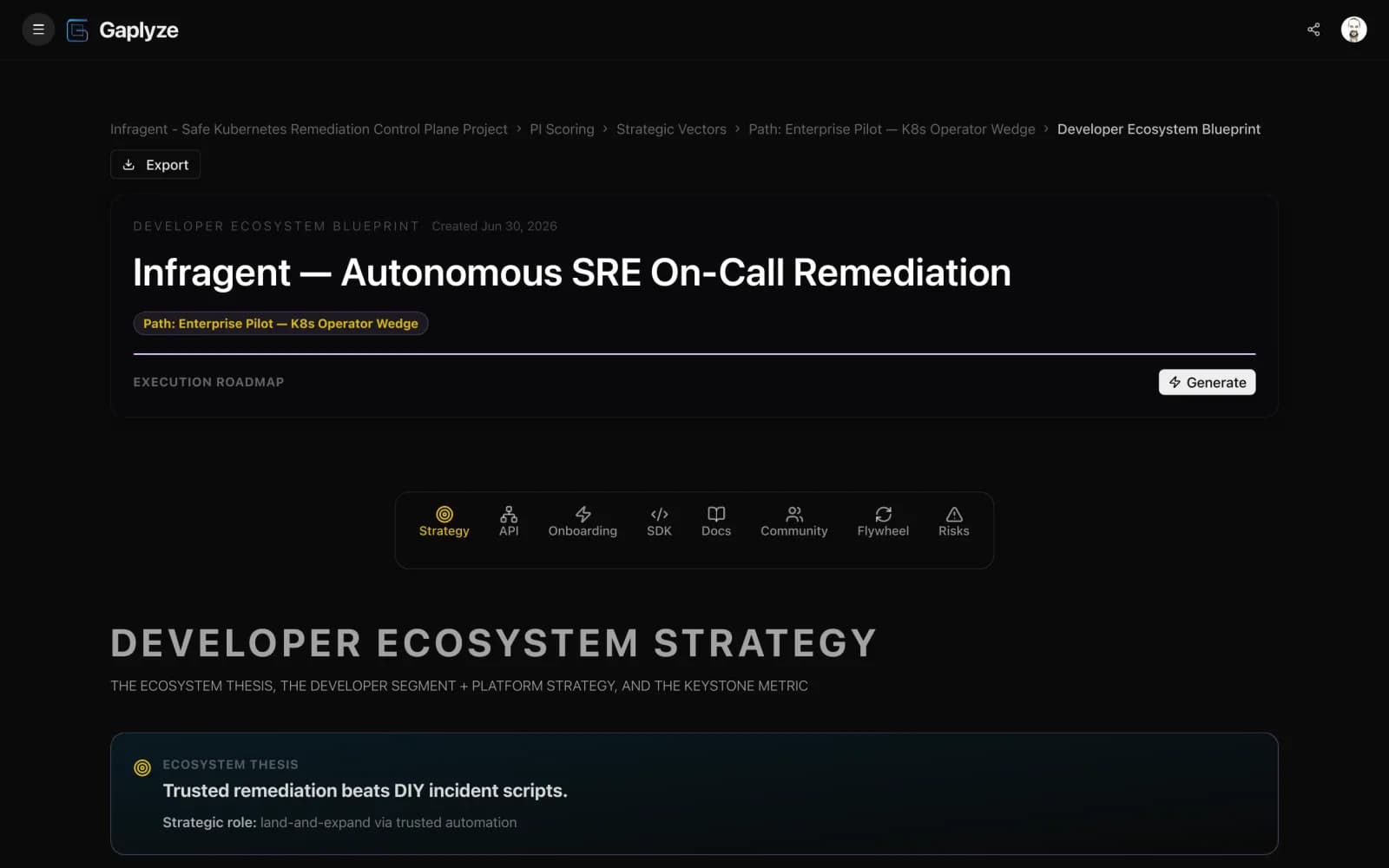
A positioning frame, an SDK portfolio, and a docs architecture.
The actual Developer Ecosystem Blueprint — the developer positioning frame, the SDK portfolio plan, and the documentation architecture that holds up as the platform grows. Open it and scroll the whole thing.
Roadmap outputs
From blueprint to delivery plan.
The execution roadmap sequences SDK / docs / DevRel work into phases with dependencies — so engineering ships the baseline before investing in the long tail.
Phase 1
API + reference docs
REST baseline + auto-generated reference + quickstart
Phase 2
First-class SDK
TS or Python (whichever your top adopter wants first)
Phase 3
DevRel motion
Community channels + design partners + content engine
Prompt-pack outputs
Briefs your AI coding agent can ship.
Every SDK and doc artifact becomes a context-rich brief — audience, language idioms, code shape — so your AI coding agent ships consistent surfaces across the portfolio.
API spec brief — OpenAPI shape + auth + rate limits
SDK scaffold brief — language idioms + error model + test suite
Quickstart brief — first-success path + sample app
DevRel content brief — concept articles + recipe library + community plan
Sibling blueprints
Pairs cleanly with — and stays distinct from — these.
Technical Blueprint
Internal architecture that the public API exposes
Non-overlap: Technical is what you build; Developer Ecosystem is how external developers consume it.
Business Model Blueprint
Developer-tier pricing and usage-based revenue
Non-overlap: Business Model defines tier economics; Developer Ecosystem defines what developers experience.
AI Agent Blueprint
How an agent integrates via the platform (e.g., MCP)
Non-overlap: AI Agent is one consumer of the ecosystem; Developer Ecosystem serves many.
Enterprise Buying Blueprint
Enterprise admin / identity controls that gate platform adoption
Non-overlap: Enterprise Buying handles procurement; Developer Ecosystem handles bottoms-up adoption.
Included with blueprints
Generate your first Developer Ecosystem Blueprint.
Start free. Upgrade only when you want the full execution roadmap and prompt pack ready for your AI coding agent.
FAQ
Developer Ecosystem Blueprint questions answered.
What's the difference between an ecosystem and a platform?
A platform is what you build. An ecosystem is the surrounding network of integrators, SDK users, content creators, and contributors that compound the platform's value. The Developer Ecosystem Blueprint frames the ecosystem motion — distinct from the technical platform itself.
Is investing in DevRel worth the cost?
Only if your product's addressable adoption depends on developers — typical for APIs, SDKs, infrastructure, and integration-heavy products. The blueprint maps when DevRel is a multiplier (high-leverage) vs a vanity expense (low-leverage).
Should I ship SDKs for every popular language on day one?
No. Ship the SDK your top three adopter segments use first. The SDK Portfolio Grid sorts language choices by demand signal — REST/HTTP first as the baseline, then language SDKs by user-base evidence.
How do I keep documentation from rotting?
Treat docs as code. The Documentation Architecture Matrix splits Quickstart / Concepts / How-tos / Reference into separate sources of truth — each with an owner, a freshness cadence, and a CI check.
Should the SDKs be open-source or proprietary?
Open-source for SDKs that wrap your public API (transparency and trust win); proprietary for the platform core itself. The blueprint frames the licensing choice by surface, not by religion.
How do I structure a community contribution model?
Tiered — issues / PRs from any contributor, design partner program for top integrators, and a maintainer track for trusted contributors. The blueprint includes the tier definitions, expected outputs, and recognition cadence.
Make the developer surface compound, not fragment.
Generate the Developer Ecosystem Blueprint built on your scored idea — and ship SDKs, docs, and DevRel that scale with adoption.