
The Competitive Analysis Playbook: How Gaplyze Powers Competitor Intelligence
Web Insights turns any URL into a competitive dossier. Market Intelligence maps named competitors with specific weaknesses. Market Gap Analyzer finds exploitable gaps. Here is how Gaplyze's three intelligence layers give you the competitive edge.
Table of Contents
Why Competitive Intelligence Is Non-Negotiable
Every SaaS idea exists within a competitive context. Even if you think your idea is unique, someone is solving a version of the same problem — maybe poorly, maybe indirectly, maybe in an adjacent market. Understanding that competitive context is not optional. It is the foundation of positioning, differentiation, and go-to-market strategy.
Most founders approach competitive research casually: they Google a few competitors, skim their websites, check their pricing pages, and form an impression. This surface-level analysis misses the intelligence that actually matters — specific competitor weaknesses, customer complaints, feature gaps, pricing opportunities, and underserved audiences.
Gaplyze transforms competitive analysis from a casual browse into a structured intelligence operation. Three features work together to give you comprehensive competitive intelligence: Web Insights for instant competitor dossiers from any URL, Market Intelligence for market-wide competitive mapping with named companies and specific weaknesses, and the Market Gap Analyzer for identifying the exploitable gaps that competitors have left open.
The goal of competitive analysis is not to replicate what others are doing. It is to understand what they are doing so you can do something meaningfully different. Gaplyze's competitive intelligence reveals where competitors are strong (do not compete here) and where they fall short (your opportunity lives here).
Gaplyze's Web Insights: Any URL to Competitive Dossier
Gaplyze's Web Insights is the fastest way to get structured intelligence on any competitor. Enter a website URL and Gaplyze produces a comprehensive competitive dossier: estimated monthly traffic, traffic source breakdown, user demographics, engagement metrics, content quality scoring, SEO assessment, mobile optimization evaluation, and load speed analysis.
But Web Insights goes far beyond traffic metrics. It produces a full business intelligence layer: monetization model analysis, competitive advantage assessment, and market positioning evaluation. It generates a complete SWOT analysis — specific features to add, identified weaknesses, current strengths, market opportunities, and competitive threats.
The most actionable Web Insights output is the recommendations section: specific priority actions, strategic guidance, and estimated impact of implementing changes. Whether you are analyzing a competitor (to find weaknesses) or your own site (to identify improvements), Web Insights produces the structured intelligence that casual browsing cannot.
Web Insights also generates two scores: an overall score (current state quality, 0-100) and a potential score (growth opportunity ceiling, 0-100). The gap between these scores tells you how much room the competitor has to improve — and whether their current weaknesses are likely to be temporary or structural.
Market Intelligence Competitor Analysis: Named Companies, Specific Weaknesses
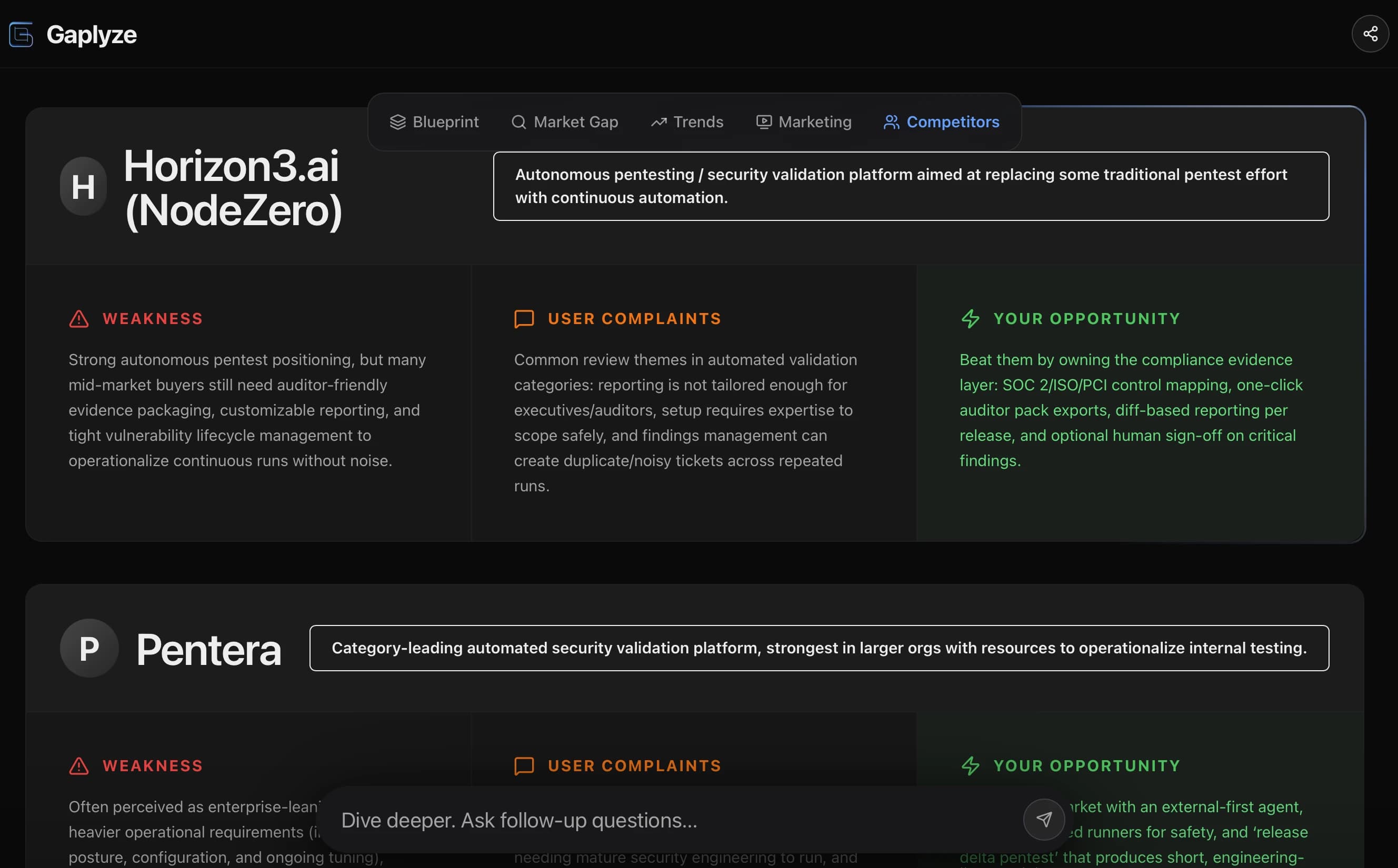
Gaplyze's Market Intelligence includes a dedicated competitor section that goes deeper than Web Insights. While Web Insights analyzes a single URL, the Market Intelligence competitor section maps the entire competitive landscape for your idea — identifying multiple real companies with specific, actionable intelligence.
For each competitor, Gaplyze provides: the company name (real, verifiable companies — not hypothetical examples), their specific weaknesses (not generic observations but concrete limitations), customer complaints from review platforms, the gap opportunity each weakness creates, and their current market positioning. This level of specificity is what transforms competitive research from 'I know who my competitors are' to 'I know exactly how to beat them.'
The Market Intelligence typically identifies three to five key competitors, each with distinct data points. This is not a list scraped from a directory — it is an analyzed competitive landscape where each player's strengths and vulnerabilities are mapped relative to your specific idea and positioning.
“Gaplyze does not just tell you who your competitors are. It tells you their specific weaknesses, what their customers complain about, and exactly where the gap opportunity exists for a new entrant.”
How to Run a Complete Competitive Analysis on Gaplyze
Start with Web Insights on Your Top Competitors
Enter each competitor's URL into Gaplyze's Web Insights. Get traffic metrics, quality scores, SWOT analysis, and strategic recommendations for each one. Compare their overall scores and potential scores to understand which competitors are strongest and which are most vulnerable. Save each analysis to a 'Competitor Intel' workspace for organized reference.
Run a Market Intelligence on Your Idea
Enter your idea and run Gaplyze's Market Intelligence. The competitor section maps the full landscape — naming real companies with specific weaknesses and gap opportunities. The Market Gap Analyzer runs seven components simultaneously to find where the market is underserved. Together, they give you both the 'who' (competitors) and the 'where' (gaps) of competitive intelligence.
Probe Specific Competitive Questions with Follow-Up Chat
Use Gaplyze's follow-up chat to dig into specific competitive angles. 'What is Competitor X's pricing strategy and where is the gap?' 'Which competitor's customer base would be easiest to win?' 'How defensible is my differentiation against the market leader?' The chat has full context of your Market Intelligence — no need to re-explain.
Identify Your Positioning from the Gaps
Gaplyze's Market Gap Analyzer reveals where to position: underserved audience detection defines your target persona, feature gap mapping defines your value proposition, pricing gap discovery defines your pricing strategy, and competitor weaknesses define your differentiation narrative. Your positioning is derived from competitive evidence, not from brainstorming.
Build Your Competitive Roadmap
Generate Gaplyze's execution roadmap to translate competitive intelligence into action. The roadmap prioritizes features that exploit the specific gaps your analysis identified — the competitor weaknesses, the underserved audiences, the missing capabilities. Each task is informed by competitive evidence, ensuring your build plan addresses real market opportunities.
Run competitive intelligence on any competitor
Enter a competitor's URL into Gaplyze's Web Insights for an instant dossier — or run a Market Intelligence on your idea to map the full competitive landscape.
How the Market Gap Analyzer Finds Exploitable Weaknesses
Gaplyze's Market Gap Analyzer is the third layer of competitive intelligence — and often the most strategically valuable. While Web Insights analyzes individual competitors and the Market Intelligence competitor section maps the landscape, the Market Gap Analyzer identifies the structural weaknesses across the entire market.
The seven components work together: Competitor scanning maps the players. Search pattern mapping reveals demand that no competitor is addressing. Pricing gap discovery finds segments left unserved by current pricing models. Review sentiment analysis surfaces the complaints that are consistent across all competitors — the systemic gaps, not just individual product issues. Underserved audience detection identifies who is being ignored. Feature gap mapping reveals the capabilities and integrations that no one offers. Opportunity size prediction quantifies how large each gap is.
The most valuable gaps are the ones that appear across multiple components. When search patterns show rising demand for a capability that no competitor offers (feature gap), that competitors' customers are complaining about (review sentiment), in a segment that existing solutions ignore (underserved audience) — that convergence is a competitive opportunity backed by evidence from multiple independent sources.
Gaplyze's gap analysis distinguishes between feature gaps (a missing checkbox that an incumbent can add easily) and structural gaps (fundamentally different approaches that require architectural changes). Feature gaps are temporary — incumbents will add them. Structural gaps are defensible — they require the kind of fundamental rethinking that large competitors resist.
Using Gaplyze's Competitive Intelligence for Positioning
Competitive intelligence is only valuable if it translates into positioning. Gaplyze's analysis produces the specific evidence you need for precise, defensible positioning.
The underserved audience detection tells you exactly who to serve — the customer segment that competitors ignore or underserve. The feature gap mapping tells you exactly what to build — the capabilities that no competitor offers. The competitor weaknesses tell you exactly how to differentiate — the specific claims you can make that competitors cannot.
Gaplyze's business blueprint section synthesizes these findings into a market positioning statement, product strategy, and recommended GTM frameworks. The positioning is specific to your opportunity because it is built on specific competitive evidence — not generic differentiators that could describe any product.
This evidence-backed positioning compounds over time. Your marketing resonates because it speaks to real pain points that competitors cause. Your sales conversations succeed because you can name the specific gaps you fill. Your product roadmap stays focused because every feature decision is informed by competitive intelligence.
Create a dedicated 'Competitor Intel' workspace in Gaplyze. Add Web Insights analyses for each major competitor, your Market Intelligence with the Market Gap Analyzer, and any follow-up chat insights. This workspace becomes your living competitive intelligence center — updated whenever you run new analyses, track new competitors, or discover new gaps.
Ongoing Competitive Monitoring with Gaplyze
Competitive analysis is not a one-time exercise. Markets shift, competitors evolve, and gaps open and close. Gaplyze supports ongoing competitive monitoring through several features.
Run periodic Web Insights on your top competitors to track changes in their quality scores, traffic, and SWOT profiles. Changes in their potential score relative to their overall score indicate strategic shifts. Declining quality scores signal opportunities. Improving scores signal threats.
Re-run Market Intelligence analyses periodically to see how the competitive landscape has shifted. New competitors may have entered. Existing competitors may have pivoted. Gaps that existed three months ago may have closed — or widened. Gaplyze's structured output makes these comparisons meaningful because the framework is consistent across time.
Check the Public Ideas for community signals about competitors. When other founders are exploring alternatives to an incumbent, that is a market signal. When a niche is trending that targets an underserved segment of a competitor's market, that is an opportunity signal. Gaplyze's community features provide early warning intelligence that no individual analysis can offer.
Start Your Competitive Intelligence Operation on Gaplyze
Enter your top competitor's URL into Web Insights for an instant competitive dossier. Run a Market Intelligence on your own idea to map the full competitive landscape with named companies and specific weaknesses. Use the Market Gap Analyzer to find the structural gaps you can exploit. Probe specific questions with follow-up chat. Generate a competitive roadmap with the execution roadmap generator.
Organize everything in a Gaplyze workspace. Build a living competitive intelligence center that grows with every analysis. The founders who win are not the ones who ignore competition — they are the ones who understand it so precisely that every product decision, positioning choice, and marketing message is informed by real competitive evidence.
That is what Gaplyze makes possible — competitive intelligence at startup speed, with the depth and structure that used to require an analyst team.
Keep Exploring
Know your competition. Own your positioning.
Run Web Insights on any competitor URL. Map the full landscape with Market Intelligence. Find exploitable gaps with the Market Gap Analyzer. Build a competitive roadmap. All on Gaplyze.
Frequently Asked Questions
How is Gaplyze's Web Insights different from tools like SimilarWeb?+
Web Insights goes beyond traffic metrics. It produces a full competitive dossier with quality scoring (content, SEO, mobile, speed), business intelligence (monetization model, competitive advantage, market position), SWOT analysis with specific actionable items, and strategic recommendations with estimated impact. It is competitive intelligence designed for startup decision-making, not just traffic analytics.
Can I analyze my own website with Web Insights?+
Absolutely. Web Insights works as both a competitive analysis tool and a self-audit tool. Enter your own URL to get quality scores, improvement recommendations, and a potential score that shows your growth ceiling. Compare your scores against competitors to see exactly where you lead and where you lag.
How many competitors does the Market Intelligence identify?+
The Market Intelligence competitor section typically identifies three to five key competitors — real, named companies with specific data on their strengths, weaknesses, customer complaints, and the gap opportunity each creates. The Market Gap Analyzer provides additional competitive intelligence through its seven components.
How often should I update my competitive analysis on Gaplyze?+
Run Web Insights on key competitors monthly or quarterly. Re-run Market Intelligence whenever you are making strategic decisions — new feature priorities, positioning changes, market expansion. Check the Public Ideas regularly for community signals about competitive shifts. Gaplyze's structured output makes periodic comparison meaningful.
Can Gaplyze help me monitor competitors over time?+
Yes. Save Web Insights analyses and Market Intelligence reports in a dedicated Gaplyze workspace. Run new analyses periodically and compare them against previous results. Changes in quality scores, SWOT profiles, and market positioning reveal competitive shifts that inform your strategy. The workspace model turns one-time analysis into ongoing intelligence.